
retirement

3 Tips to Keep Your Retirement Safe
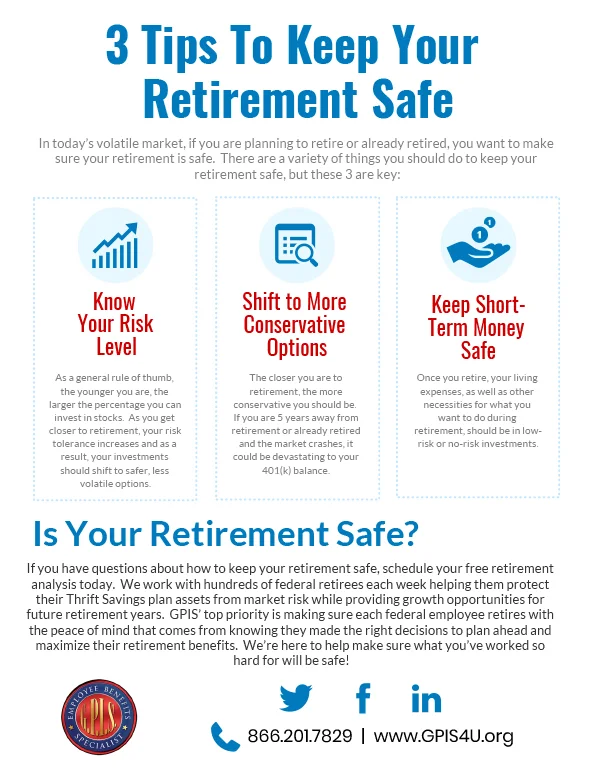
 In today’s volatile market, if you are planning to retire or already retired, you want to make sure your retirement is safe. There are a variety of things you should do to keep your retirement safe, but these 3 are key:
Know Your Risk Level
As a general rule of thumb, the younger you are, the larger the percentage you can invest in stocks. As you get closer to retirement, your risk tolerance increases and as a result, your investments should shift to safer, less volatile options.
Shift To More Conservative Investments
The closer you are to retirement, the more conservative you should be. If you are 5 years away from retirement or already retired and the market crashes, it could be devastating to your 401(k) balance. Younger investors don’t have to worry as much about volatile markets because they have time on their side.
Keep Short-Term Money Safe
Once you retire, your living expenses, as well as other necessities for what you want to do during retirement, should be low-risk or no-risk investments.
Is Your Retirement Safe?
If you have questions about how to keep your retirement safe, schedule your free retirement analysis today. We work with hundreds of federal retirees each week helping them protect their Thrift Savings plan assets from market risk while providing growth opportunities for future retirement years. GPIS’ top priority is making sure each federal employee retires with the peace of mind that comes from knowing they made the right decisions to plan ahead and maximize their retirement benefits. We’re here to help make sure what you’ve worked so hard for will be safe!
Thrift Savings Plan investment limit to increase to $19,000 in 2019

The Internal Revenue Service announced cost of living adjustments affecting dollar limitations for pension plans and other retirement-related items for tax year 2019. The highlights include:
- The contribution limit for employees who participate in the federal government’s Thrift Savings Plan, 401(k), 403(b), and most 457 plans increased from $18,500 to $19,000.
- If you are 50 and over and participate in 401(k), 403(b), most 457 plans and the Thrift Savings Plan, your catch-up contribution limit remains unchanged at $6,000 for 2018.
Catch-up Contributions
With the end of the year quickly approaching, be sure to take advantage of catch-up contributions. Here are a few tips to keep in mind:
- You can make your catch-up contribution at any time, but it has to be made by the end of the calendar year. You will have to create a new catch-up contribution election each year.
- To get started making TSP catch check out the Catch-Up Contributions fact sheet on TSP.gov or watch the Catch-Up Contributions video on YouTube.To get started making TSP catch check out the Catch-Up Contributions fact sheet on TSP.gov or watch the Catch-Up Contributions video on YouTube.
Questions About Your Federal Benefits?
If you have questions about maximizing your federal benefits, schedule your free retirement analysis today. Each member of our expert staff has extensive background working with the federal government, federal employees, and retirement planning. GPIS’ top priority is making sure each federal employee retires with the peace of mind that comes from knowing they made the right decisions to plan ahead and maximize their retirement benefits. We’re here to help!
Thinking about a Part-Time Job? Social Security and Medicare Implications

If you are like many federal government or USPS retirees, you are contemplating a part-time job to help supplement your retirement benefits and savings. Many don’t realize that a part-time job can have Social Security and Medicare implications. Here are some things to keep in mind:
- If you start taking Social Security before your full retirement age, earning more than $17,040 from work will reduce your benefits temporarily.
- Once you’re on Medicare, extra income could potentially trigger surcharges for parts B and D.
- Also, don’t overlook your required minimum distributions from retirement accounts once you reach age 70½.
Case In Point
We know of a man who took Social Security at age 62 and got a bill from them for $2,000 when he was 65 because his new career made more than his previous one. Of course the new job was too lucrative to quit over the $2,000, but a shocker nevertheless.
Free Retirement Analysis
If you are contemplating returning to work and would like a FREE personal benefit review visit our website or call 866-201-7829.
How Does My Health Insurance Work When I Retire?
At GPIS we help hundreds of federal employees retire every week and one of the biggest questions we get is: How does my health insurance work when I retire? When we visit with federal employees, we share the following tips:
- You must have at least 5 consecutive years going into retirement to carry your Federal Health Plan.
- Depending upon which federal agency you are employed, there could be increases in cost.
- You will be able to change your health plan each year after retirement during open enrollment.
- The employee must have the 5 consecutive years to continue to receive health care benefits, not the spouse
- The 5 consecutive years does not have to be with the same federal health plan.
- Some health plans require Part B Medicare and some do not.
- You should speak with a professional to find out if Medicare is right for you and explore all of your health options.
If you have additional questions on how your health insurance will work when you retire, schedule your FREE Retirement Analysis today.
Each member of our expert staff has extensive background working with the federal government, federal employees, and retirement planning. GPIS’ top priority is making sure each federal employee retires with the peace of mind that comes from knowing they made the right decisions to plan ahead and maximize their retirement benefits. We’re here to help!
Federal Retirement Claims Up in 2018

The Office of Personnel Management released earlier this month the number of federal employees filing retirement claims is on the increase.
The Numbers
Between January and July 2017, 59,987 federal employees had filed retirement paperwork with OPM. But over the same period this year, that number increased to 69,340.
One in seven federal workers is eligible to retire today, a rate that reaches as high as one in five at a few agencies. The Housing and Urban Development Department, the Environmental Agency and NASA are the federal agencies with the highest proportion of employees eligible to retire.
What Does This Mean?
If you are in the process of filing a retirement claim or thinking about retiring don’t wait any longer to sign up for GPIS’ FREE Retirement Analysis. We provide professional, practical and individual information in the complex field of retirement planning.